


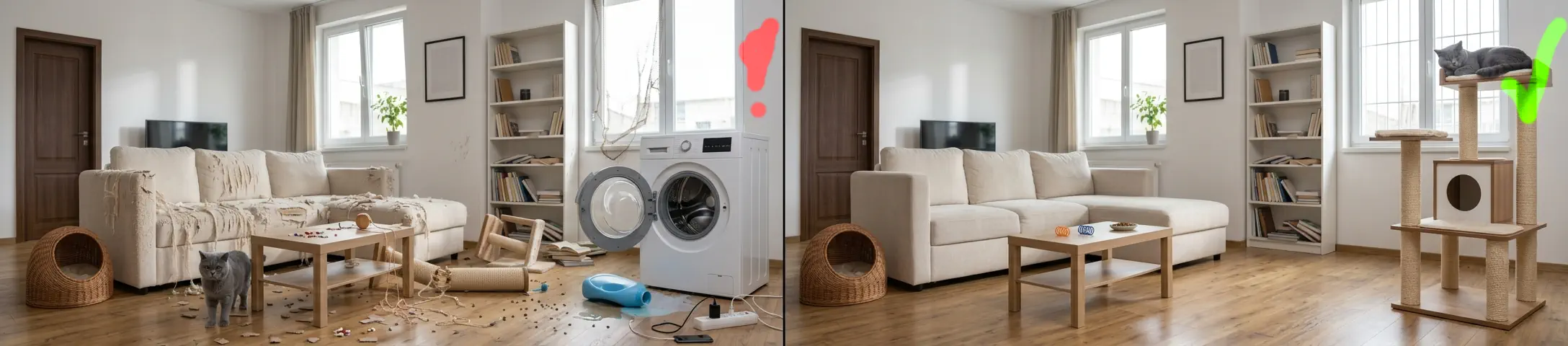
When we think of dangers to a cat, we imagine speeding cars and strange dogs. Meanwhile, veterinary statistics are ruthless: the most tragic accidents happen within the four walls of what seems to be a safe home.
Kittens from British Rainbow*PL leave the cattery as healthy, joyful, and... incredibly curious creatures. Their instinct tells them to check every corner, climb every height, and taste everything lying on the floor.
Treat this article as a mandatory checklist. Before your new friend crosses the threshold, you must look at your apartment from the perspective of a small, fluffy predator.

1. Windows and Balcony: Death Trap No. 1 🪟
This is the most important point of this article. The myth that "a cat always lands on its feet" has already killed thousands of animals. A British Shorthair is massive and heavy. A fall even from the 1st or 2nd floor can result in a ruptured bladder, a fractured pelvis, or internal bleeding.
A. Tilted Window Syndrome (The Silent Killer)
Do you tilt your window to ventilate? For a cat, that gap is an invitation to go outside. The cat tries to jump out, gets wedged in the narrowing gap, and... slides down. Their own weight crushes internal organs and the spine. Death occurs in agony through suffocation or crushing.
- Solution: Install special protective grilles for the sides and top of the window (cost approx. €7–€12 / $8–$13) or opening limiters. Never leave a cat alone with a tilted window without protection.
B. Balcony and Open Windows
If you want to open windows wide or let your cat out onto the balcony – a safety net is a necessity, not a whim. A mosquito net is not enough (a cat will tear it with one swipe of a claw).
- Solution: Wire-reinforced netting or special polyethylene netting (transparent or olive). Installation can be commissioned from a professional company or done yourself on non-invasive frames.

2. Invisible Enemies: Chemicals and Medicines 🧪
Cats walk on countertops, tables, and floors. Then they wash their paws with their tongues. Everything that was on the surface ends up in their system.
- Detergents: Floor cleaners, toilet cleaners (especially those hanging in the bowl – cats like to drink from the toilet!), bleaches. They must be locked in cabinets.
- Human Medicines: A Paracetamol or Ibuprofen tablet that falls on the floor is a deadly poison to a cat. One tablet can destroy the liver and kill the animal in a few hours.
- Essential Oils: Popular scent diffusers or tea tree oils are highly toxic to cats when inhaled or through skin contact.

3. "String Syndrome": Toys That Kill 🧵
Cats have hooks on their tongues pointing towards the throat. If they take the end of a thread, string, or ribbon into their mouth, they are often unable to spit it out – they must swallow it. This leads to so-called linear foreign body obstruction. The intestines "thread" onto the string like an accordion. This is a life-threatening condition requiring immediate, risky surgery.
What to remove from the cat's reach?
- Hair ties (cats love them and swallow them whole).
- Ribbons from gifts.
- Dental floss and sewing threads.
- Christmas tinsel (at British Rainbow*PL, we don't use it at all!).
- Plastic bag handles (cats chew them and swallow fragments).

4. Kitchen and Appliances: Warm Caves 🔥
Cats love warmth and tight spaces. Appliances are an ideal hiding place for them.
- Washing Machine and Dryer: Before you start a load, ALWAYS check the drum. Kittens love sleeping in a pile of dirty clothes inside the machine.
- Cooktop: Cats jump onto countertops. Induction hobs cool slowly; gas hobs burn with fire. Try not to leave hot pots unattended and close the kitchen after cooking if possible, or use stove covers.
- Dishwasher: Close it immediately after loading/unloading. A cat could climb inside and get stuck or cut themselves on knives.

5. Cables and Wires: Electric Chew Toys ⚡
A teething kitten (or a bored adult cat) may treat a charger cable like a chew toy. Biting through a live cable risks electric shock (often fatal) or mouth burns.
- Solution:
- Hide cables in conduits/trunking.
- Wrap loose cables (e.g., from lamps, computers) in special cable protectors (plastic protective tubes).
- Coat cables with a special bitter-tasting liquid (e.g., Bitrex), available at pet stores.

6. Furniture Obstacle Course 🛋️
British Shorthairs are not light ballerinas. An adult male can weigh 6-8 kg (13-18 lbs). When such a "heavyweight" jumps on an unstable shelf or plant stand, the furniture can collapse.
- Secure Your Furniture: It's worth anchoring tall dressers and wardrobes to the wall (just like with a small child).
- Gaps: Check if there are gaps behind kitchen cabinets or the fridge where a kitten could enter but won't be able to get out.
- Scratching Posts: When buying a scratching post, choose those with a heavy, wide base. A cheap, light pillar will tip over during your Brit's first jump.
🐾 Want to perfectly prepare your home for a kitten?
All our guides, safety checklists, and proven breeder tips have been gathered by us in one place.
I want to discover all expert tips! →